
Wyoming Release Dates Mean Different Things
Start by naming the date. A pretrial detainee usually has no sentence-based projected discharge date. The next custody event may depend on bond, a hearing, dismissal, plea, or another court order. A sentenced person can have a computed minimum discharge date, but that projection remains subject to the sentence, credit, and conduct rules.
WVDCR Policy 142.00 uses the public-record term projected minimum discharge date. Conditional Release Policy 454.10 describes the minimum discharge date or final release date as scheduled on the assumption of continuous incarceration and no loss of good time. That is narrower than a promise to leave on a set day.
| Date | What it means | What it does not mean |
|---|---|---|
| Projected minimum discharge date | Current DCR sentence calculation under stated assumptions | A guaranteed appointment at the release door |
| Parole eligibility date | Earliest point for possible parole consideration under the governing rules | A hearing appointment, grant, or release date |
| Parole decision date | Date the Board acted | The time a regional-jail grantee physically left |
| Actual release date and time | When the custodian recorded departure | Automatic end of parole or other supervision |
| Supervision discharge date | Later end of a supervision relationship | The original facility exit date |
Find a Wyoming Projected Release Date
The correct lookup changes with custody type. Southern Regional Jail handles the main Wyoming County regional-jail path. WVDCR's prison system handles a state commitment. The court holds the order that established the sentence and awarded presentence credit.
- Identify the custody stage. Determine whether the person is pretrial, serving a regional-jail sentence, or committed to a state prison.
- Use the proper WVDCR search. Start at the official offender-search gateway. Choose jails for current regional-jail custody or prisons for state-prison custody.
- Match the person. Compare name, birth date or age, OID, facility, court docket, and offense. Do not rely on a name alone.
- Read the exact label. Record whether the source says projected minimum discharge, parole eligibility, full-term expiration, or actual release.
- Get the source calculation. Ask WVDCR for the current timesheet or sentence calculation when the online screen does not show the needed field.
- Compare the court order. Check the certified commitment and sentencing order for term structure and court-awarded jail credit.
- Verify later changes. Ask whether good time was lost or restored, another sentence was combined, a detainer exists, or the court entered a later order.
The research environment could not inspect the live prison OIS labels because the interactive endpoint was blocked. Policy 142.00 proves that WVDCR treats the projected minimum discharge date and related calculation fields as public categories. It does not prove each field appears on every online result. Keep the records-request fallback when the display is incomplete.
Wyoming Release Uses One-for-One Credit
West Virginia does not have a verified general rule that every eligible inmate must serve 85 percent of the sentence. That shorthand should not be imported from the federal system. Under West Virginia Code section 15A-4-17, an eligible inmate generally receives one day of good time for each day physically incarcerated. The credit is deducted from the maximum term of an indeterminate sentence or from the fixed term of a determinate sentence.
Court-credited presentence jail time counts under the cited framework. Time spent on parole, bond, or another nonincarcerated status does not count as physically incarcerated time for this good-time credit. Life-sentenced inmates do not receive it. Consecutive sentences are combined for calculation, so adding credits to only one sentence can produce a false answer.
Good time is not fixed forever. Disciplinary violations can cause forfeiture, and DCR can restore credit. The commissioner may award extra credit for meritorious or emergency service. An eligible felony inmate may also earn up to 90 days for successfully completing an approved academic or vocational program that was not already required by the individualized reentry plan. Those changes explain why two valid DCR statements issued at different times may show different projections.
Note: Use WVDCR's current calculation, not a homemade percentage or arithmetic drawn from a news report.
What Changes Wyoming Release Projections
A projection reflects the information available when DCR calculates it. The strongest check pairs the current DCR timesheet with the certified court order. The following factors can move the date or change what occurs at that date.
| Factor | Possible effect | Best record to check |
|---|---|---|
| Presentence jail credit | Moves credited custody time into the computation | Sentencing order and DCR timesheet |
| Good-time forfeiture | Can push the minimum discharge point later | Revised DCR calculation |
| Good-time restoration | Can move the projection earlier again | Revised statement from DCR |
| Approved program credit | Can add limited extra credit for an eligible completion | DCR program and calculation record |
| Consecutive sentences | Combines terms for calculation | Judgment, commitment order, and timesheet |
| New court order or corrected credit | Changes the legal inputs | Filed court order and recalculation |
| Detainer or transfer | May send the person to another custodian instead of the community | Release method and transfer destination |
A detainer is a notice that another authority may seek custody. It does not necessarily change the sentence calculation, but it can change where the person goes when WVDCR custody ends. The release record's method and destination fields help distinguish a community exit from a handoff.
Wyoming Release May Start Supervision
For specified felony offenses committed on or after July 1, 2013, subsection 15A-4-17(k) converts one year of accumulated good time into mandatory post-release supervision. The covered groups include certain violence-against-person, minor-victim, and firearm offenses. Electronic or GPS monitoring applies under that subsection. For other felonies, subsection (l) permits a sentencing court to direct up to 180 days of mandatory post-release supervision.
This rule can turn the calculated facility endpoint into the start of supervision rather than the end of all state control. The person may be physically released and still have reporting and monitoring duties. Confirm both the actual WVDCR release event and the supervision record.
- Good time
- Credit that can reduce the incarceration calculation for an eligible inmate.
- Mandatory post-release supervision
- A required supervision period that may follow physical confinement under the statute.
- Detainer
- A request or notice tied to possible custody by another authority.
- Discharge
- The documented end of custody or supervision, depending on the record's label.
Wyoming Parole Has Another Clock
Parole eligibility is separate from the projected minimum discharge date. Under section 62-12-13, the baseline is the minimum term of an indeterminate sentence or one fourth of a definite term. Criminal history, offense, life-sentence rules, offense date, programming, and other statutory terms can alter eligibility.
Section 62-12-13a expressly treats the minimum term as eligibility, not a right to release. PED means parole eligibility date. It is not a hearing appointment, Board grant, projected discharge date, or promised exit date. The Board schedules eligible inmates under its process, then may grant or deny parole.
A regional-jail parole grant can also precede physical release. The Board says the grantee transfers for DCR intake and fingerprinting and advises allowing roughly seven to ten days before actual release. The grant date should not be published as the release date. Verify the WVDCR log. Post-release supervision and the difference between parole and probation are covered on the Wyoming County probation and parole page.
Correct Wyoming Release-Date Errors
For a suspected DCR calculation error, the Parole Board contact page directs timesheet, PED, jail-credit, and good-time questions to DCR Records Manager Richard Doss at 304-558-2036. Be ready to identify the person by full name, OID, sentencing court, case number, facility, and the date shown on the disputed calculation.
Compare that calculation with the certified sentencing or commitment order. If the problem comes from court-awarded credit or the wording of the order, raise it through counsel and the Wyoming County Circuit Clerk or court. If the order is correct but the DCR timesheet or OIS entry differs, seek correction from DCR. Preserve copies of the screen, order, timesheet, and response.
WVDCR Central Office and Records
1409
Greenbrier Street
Charleston, WV 25311
Sentence-calculation
contact: Richard Doss
304-558-2036
Wyoming County Circuit Clerk
Tony
Paynter
24 Main Avenue, P.O. Box 190
Pineville, WV
24874
304-732-8000
Fax: 304-732-7262
West Virginia FOIA allows a reasonably specific written request for nonexempt public records. WVDCR Policy 142.00 identifies the projected date, good-time allowance and rate, credited jail time, parole eligibility, full-term expiration, actual release, and discharge method among public categories. Request only the fields and date range needed.
Verify Wyoming County Actual Release
A projection answers when custody may end if its assumptions hold. It cannot confirm that the person left. On or after the expected date, check the correct jail or prison system, inspect the court case for later orders, and obtain the WVDCR actual release date and time. If the person disappears from Regional Jail OIS, search prison OIS before calling it a release.
VINE can provide a custody-change alert, but West Virginia warns that no call occurs while a person moves facility-to-facility. Notice follows arrival. A quiet interval or delayed alert can therefore reflect transfer. The Wyoming County VINELink inmate search explains the alert and PIN caveats.
Finally, read the method and destination. A community destination can support release from custody. Another correctional facility or authority indicates transfer. A parole or mandatory-supervision notation means physical confinement may have ended while legal supervision continues. Keep the projected date, actual date, and supervision discharge date separate.
Wyoming Good-Time Statute Source
The official West Virginia good-time statute is the controlling source for the one-for-one framework, exclusions, forfeiture, restoration, added credit, and mandatory-supervision conversion.
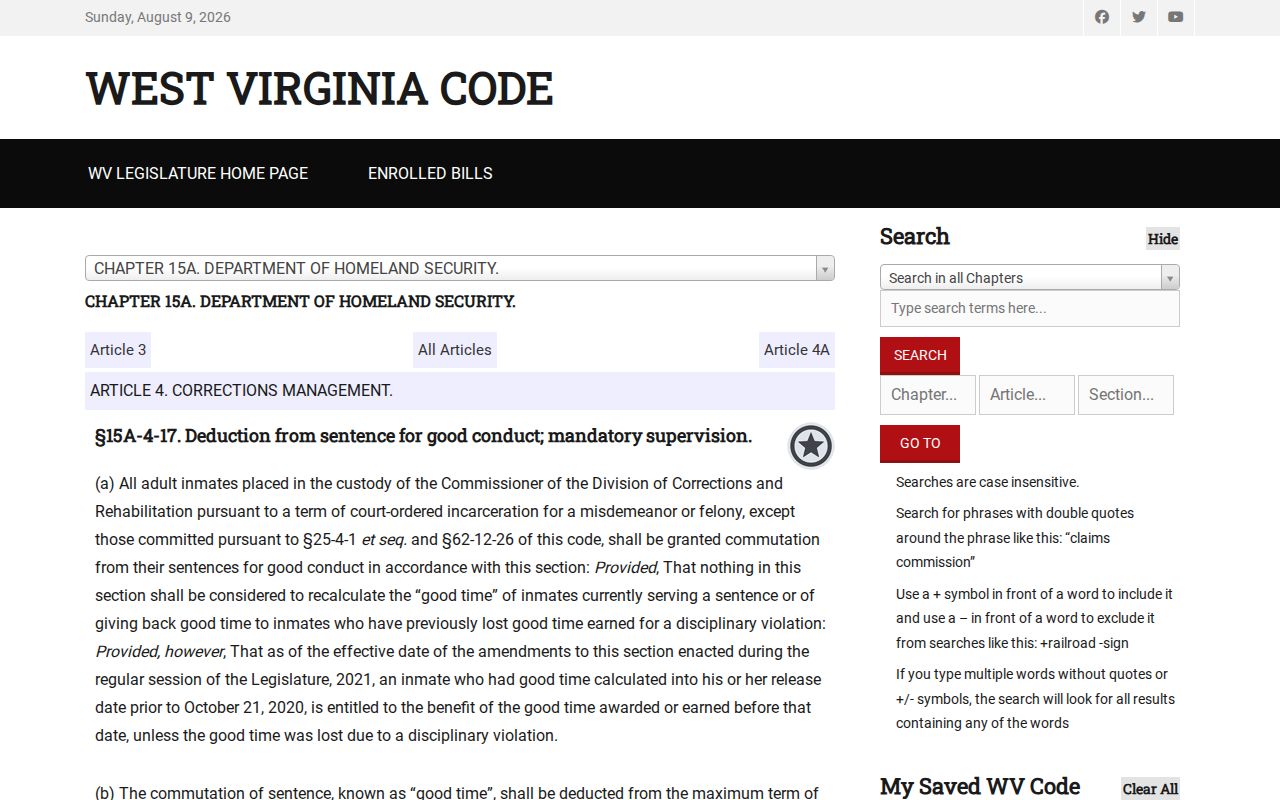
The statute should be read with the current DCR timesheet and sentencing order because the general rule does not calculate an individual Wyoming County case by itself.